The New Generation of High-Capacity Hard Drives (2024–2026): Models, Failure Trends, and Why Data Recovery Is Getting Harder
Executive Summary
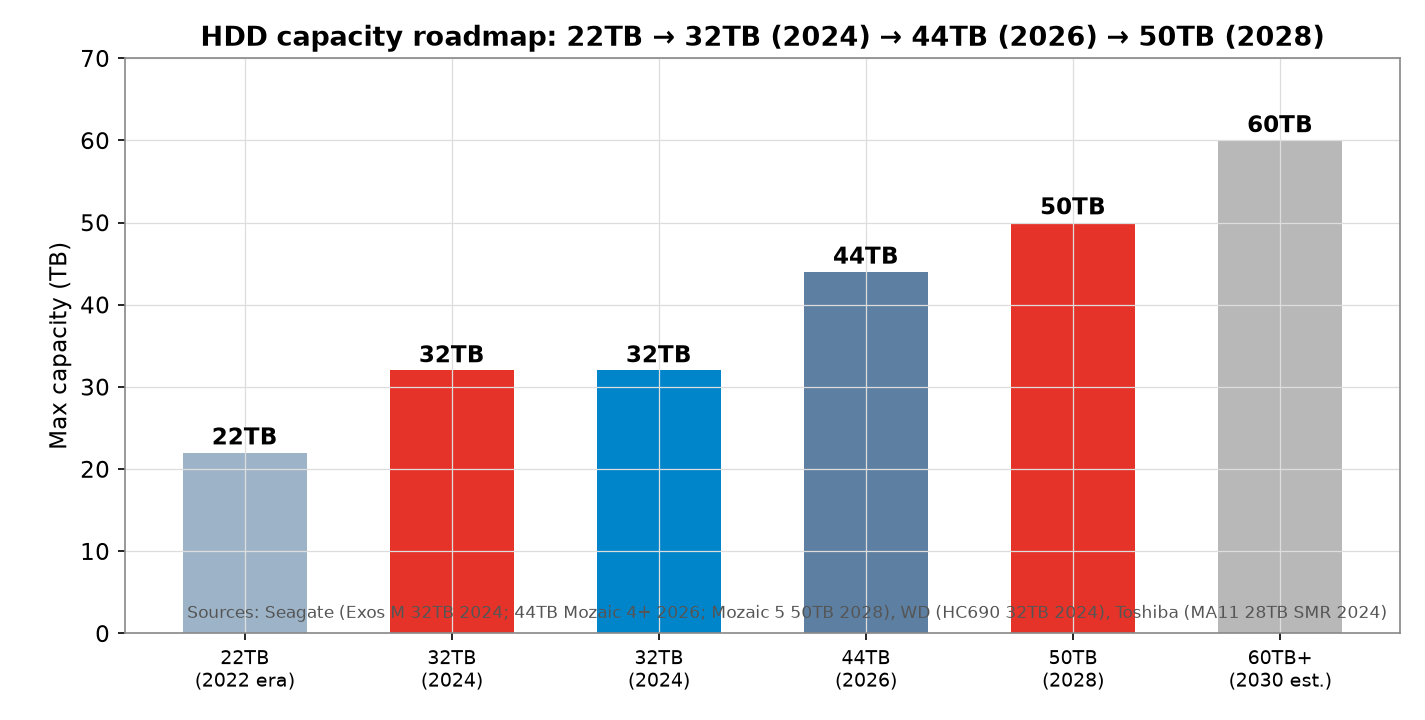
Between 2024 and 2026 the hard disk drive industry crossed three quiet but decisive thresholds. Seagate finally shipped HAMR (heat-assisted magnetic recording) drives to the open market with the Exos M family (December 2024), WD pushed conventional ePMR designs to 26 TB (CMR) and 32 TB (SMR) on an industry-first 11-disk platform (October 2024), and Toshiba introduced the helium-sealed Mx11 family — MG11 (24 TB CMR) and MA11 (28 TB SMR) (September 2024). By mid-2026 Seagate was already shipping 44 TB Mozaic 4+ drives to hyperscalers and had announced 50 TB-class Mozaic 5 qualification for late 2027.
These drives deliver stunning density — 2.4 to 3+ TB per platter, 10 to 11 platters in a standard 3.5-inch chassis — but they also fail differently and are materially harder to recover data from.
The headline from real fleet data (Backblaze, ~300,000 drives, Q1 2024–Q1 2026): the 20 TB+ class is not uniformly reliable. In calendar 2025 the Seagate 24 TB (ST24000NM002H) posted a 2.75 % annualized failure rate — roughly 6× the WD 22 TB (0.47 %) and 4× the Toshiba MG11 24 TB (0.68 %) — and its quarterly AFR kept climbing to 3.5 % by Q4 2025. Meanwhile, one of the most spectacular “failure spikes” of 2025 — a 16.96 % quarterly AFR on Toshiba’s 16 TB MG08ACA16TEY — was caused by a firmware update, not by any mechanical defect.
For data recovery, the same technologies that enable 30+ TB in one drive create a perfect storm: weaker magnetic signals at >3 Tb/in² densities, thinner glass platters, three-stage actuators, hardware encryption (SED/ISE) in nearly every enterprise model, SMR zone layouts, and firmware that can brick a healthy drive or lock out its PCB.
1. The 2024–2026 HDD Generation: Models and Specifications
1.1 Seagate — Exos M (Mozaic 3+, HAMR)
After more than a decade of development, Seagate brought HAMR to general availability on 17 December 2024. The Exos M family is built on the Mozaic 3+ platform with 3 TB per platter and uses a platinum-alloy (FePt) magnetic medium written with a laser-assisted head. All models are helium-sealed, 7,200 rpm, SATA 6 Gb/s, with a 512 MB cache, 2.5-million-hour MTBF and a rated AFR of 0.35 %.
| Model | Capacity | Recording | Platters | Density | Interface | RPM | Cache | Helium | SED/ISE |
|---|---|---|---|---|---|---|---|---|---|
| ST32000NM004K | 32 TB | SMR (HAMR) | 10 | ~3.2 TB/pl | SATA 6 Gb/s | 7200 | 512 MB | Yes | ISE; SED opt. |
| ST30000NM004K | 30 TB | CMR (HAMR) | 10 | 3.0 TB/pl | SATA 6 Gb/s | 7200 | 512 MB | Yes | ISE; SED opt. |
| ST28000NM003K | 28 TB | CMR (HAMR) | 10 | 2.8 TB/pl | SATA 6 Gb/s | 7200 | 512 MB | Yes | ISE; SED opt. |
| ST24000NM001K | 24 TB | CMR (HAMR) | 10 | 2.4 TB/pl | SATA 6 Gb/s | 7200 | 512 MB | Yes | ISE; SED opt. |
Sources: Seagate Exos M datasheet DS2045-4 (v1.2, Nov 2025); Seagate Exos M SATA Product Manual 210048100 Rev C (March 2025); Tom’s Hardware, 17 Dec 2024.
Key details from the official product manual: all Exos M models carry RSA-3072 signed firmware (SD&D — Secure Download & Diagnostics), support Fast Format 512e↔4Kn conversion, and the ISE (Instant Secure Erase) models ship with crypto-scramble sanitize support. Self-Encrypting Drive (SED) variants implement TCG Opal/Enterprise “security of data at rest.”
1.2 Western Digital — Ultrastar DC HC690 / HC590 (ePMR)
On 15 October 2024 WD announced the industry’s first 11-disk HDD platform, using energy-assisted perpendicular magnetic recording (ePMR) plus OptiNAND and ArmorCache technologies and a three-stage actuator.
| Model | Capacity | Recording | Disks | Density | Interface | Seq. transfer | Idle power | Helium | SED |
|---|---|---|---|---|---|---|---|---|---|
| Ultrastar DC HC690 | 32 TB | UltraSMR (ePMR) | 11 | ~2.9 TB/disk | SATA 6 Gb/s, SAS 12 Gb/s | 257 MiB/s | 5.5 W | Yes | Opt. |
| Ultrastar DC HC590 | 26 TB | CMR (ePMR) | 11 | ~2.4 TB/disk | SATA 6 Gb/s, SAS 12 Gb/s | 288 MiB/s | 5.6 W | Yes | Opt. |
Sources: WD press release, 15 Oct 2024; StorageReview, 22 Oct 2024; Tom’s Hardware, 15 Oct 2024. The HC590 is the direct successor to the 24 TB HC580; WD Gold 26 TB SATA variants cover NAS/channel markets (announced March 2025, $569 MSRP).
1.3 Toshiba — MG11 (CMR) and MA11 (SMR), the Mx11 family
On 10 September 2024 Toshiba announced the Mx11 family: 10-disk, helium-sealed, 7,200 rpm drives built on 2nd-generation FC-MAMR (Flux Control – Microwave Assisted Magnetic Recording) with a 1 GiB buffer, 550 TB/year workload rating, 2.5 M-hour MTTF and 0.35 % AFR.
| Series | Capacity | Recording | Disks | Density | Interface | Transfer | Buffer | SED/SIE |
|---|---|---|---|---|---|---|---|---|
| MG11 (MG11ACA24TE, …) | 14–24 TB | CMR | 10 | 2.4 TB/disk | SATA 6 Gb/s, SAS 12 Gb/s | 295 MiB/s | 1 GiB | SIE + SED opt. |
| MA11 (MA11ACA28TE, …) | 27–28 TB | SMR (host-managed) | 10 | 2.8 TB/disk | SATA 6 Gb/s | ~250 MiB/s | 1 GiB | SED opt. |
Sources: Toshiba press release, 10 Sep 2024 (toshiba-storage.com); Toshiba MG11 Series product page (storage.toshiba.com).
1.4 Consumer / nearline highlights (2025–2026)
- Seagate IronWolf Pro 30 TB & Exos 30 TB — first mass-market HAMR drives, widely available from July 2025 (Tom’s Hardware).
- WD Red Pro 26 TB — first 26 TB NAS drive (March 2025).
- Seagate 44 TB Exos (Mozaic 4+) — began shipping to two hyperscale customers in March 2026; 10 platters at >4 TB/platter (Tom’s Hardware).
2. Verified Failure Statistics: What the Data Shows
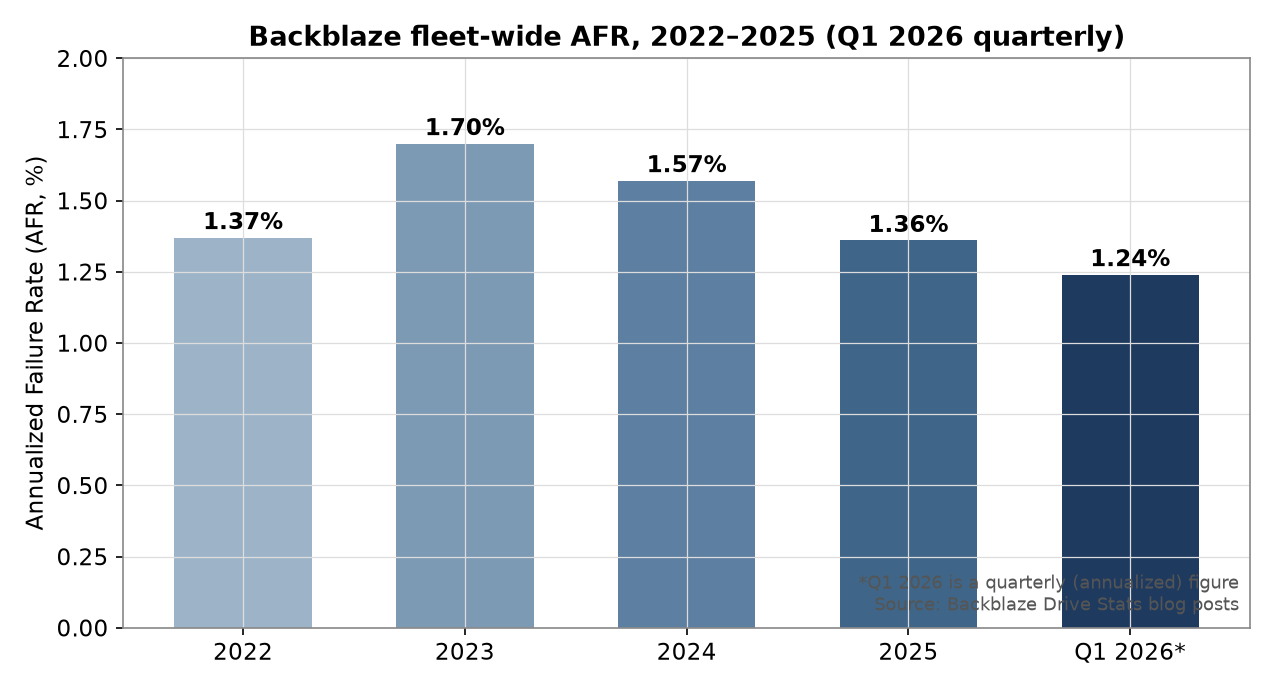
All failure figures in this section were computed from Backblaze’s raw quarterly drive stats (public CSV data, Q1 2024–Q1 2026) using the same drive-days methodology Backblaze uses (AFR = failures / (drive-days / 365.25) × 100), and cross-checked against the published Drive Stats blog posts.
2.1 Fleet-wide trend (Backblaze published figures)
| Year | Backblaze AFR |
|---|---|
| 2022 | 1.37 % |
| 2023 | 1.70 % |
| 2024 | 1.57 % |
| 2025 | 1.36 % |
| Q1 2026 (quarterly) | 1.24 % |
The headline: failure rates keep falling even as drives get bigger — because the fleet is shifting to newer, denser drives. The 2025 AFR (1.36 %) is the lowest since 2022.
2.2 Annual AFR of the new 20 TB+ models (our calculations)
Calendar 2025 (full-year, drive-days method):
| Model | Capacity | Avg. drives | Failures | AFR 2025 |
|---|---|---|---|---|
| WDC WUH722222ALE6L4 (Ultrastar HC570) | 22 TB | 3,403,220 | 177 | 0.47 % |
| WDC WUH722626ALE6L4 (Ultrastar HC590) | 26 TB | 22,922 | 1 | 0.40 % |
| TOSHIBA MG10ACA20TE | 20 TB | 1,227,345 | 80 | 0.60 % |
| TOSHIBA MG11ACA24TE | 24 TB | 93,522 | 7 | 0.68 % |
| ST24000NM002H (Seagate Exos 24 TB) | 24 TB | 485,252 | 146 | 2.75 % |
Calendar 2024: WD 22 TB (WUH722222ALE6L4) — 1.07 %; Toshiba MG10 20 TB — 0.87 %.
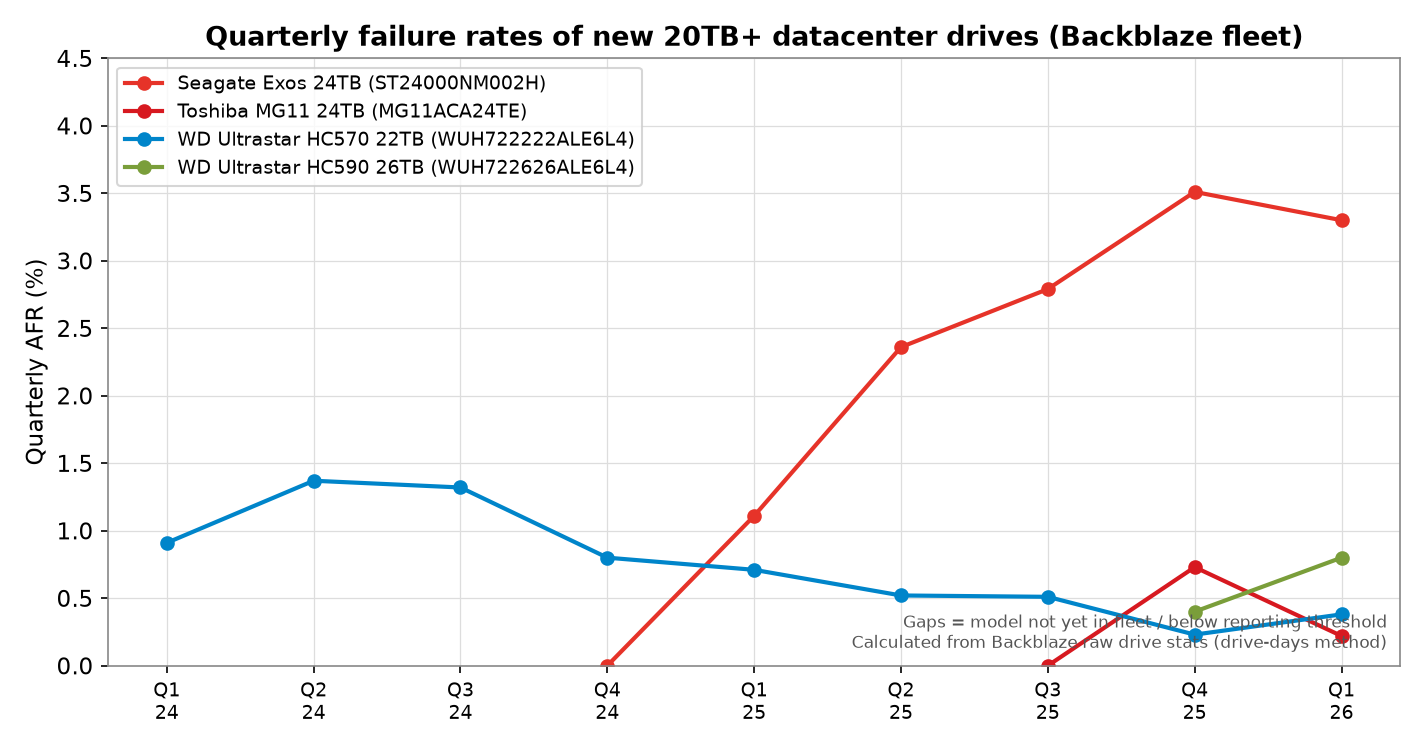
Quarterly AFR of the Seagate 24 TB (ST24000NM002H) — the outlier story:
| Quarter | Q4 2024 | Q1 2025 | Q2 2025 | Q3 2025 | Q4 2025 | Q1 2026 |
|---|---|---|---|---|---|---|
| AFR | 0.00 % | 1.11 % | 2.36 % | 2.79 % | 3.51 % | 3.30 % |
| Avg. drives | 196 | 2,560 | 4,754 | 6,538 | 7,352 | 9,112 |
The Seagate 24 TB arrived in December 2024 (1,200 drives, zero failures in Q4 2024), then its AFR rose every quarter to 3.5 % — well above the 20 TB+ pool average (0.7–0.85 %) and above even the fleet-wide average (1.36 %). This is real infant mortality on a first-generation platform, not a statistical artifact: the drive count is large and the failures are 146 for the year. Backblaze flagged the model as the weakest of the 20 TB+ trio as early as Q2 2025.
For contrast, the same calculation for the WD 22 TB (WUH722222ALE6L4) shows a textbook maturing curve: 1.37 % → 1.32 % → 0.80 % → 0.71 % → 0.52 % → 0.51 % → 0.23 % → 0.38 % (Q2 2024–Q1 2026).
2.3 The firmware “failure” that wasn’t hardware (Q3 2025)
In Q3 2025 the Toshiba MG08ACA16TEY (16 TB) model posted a staggering 16.96 % quarterly AFR in our calculation — an extreme outlier (>5.88 % by Backblaze’s own quartile test). Backblaze investigated and explained it openly: the drives were pulled for a firmware update Toshiba provided to optimize performance; the “failures” were drives out of the fleet during reflash, not dead hardware. The next quarter the model’s AFR dropped back to 4.14 %, then 2.18 %.
This is the single best real-world illustration of the article’s core thesis: in the 2024–2026 generation, firmware is increasingly the story of “failed” drives — and that has direct data-recovery consequences (Section 4).
2.4 Manufacturer-level picture (Backblaze 2024 annual report)
- WDC — most consistent; quarterly AFR range 0.0–0.85 % in 2022–2024.
- Toshiba — very stable, ~1.2 % typical; no outlier hardware models (highest quarterly 1.58 % before the Q3 2025 firmware spike).
- Seagate — improving overall (2.25 % → 2.0 % quarterly AFR 2022→2024) thanks to retiring the troublesome 4 TB models, but several older 12–14 TB models (ST12000NM0007 11.4 % in 2024, ST14000NM0138 5.3 %) and the new 24 TB (2.75 % in 2025) are the weak spots.
- HGST 12 TB (HUH721212ALN604/ALE604) — the biggest aging-outlier cluster in 2024 (5.65 % / 3.30 %).
3. Why the New Drives Fail Differently
- HAMR is new physics. Exos M drives write with a laser-heated head onto FePt media. Head-media interaction, laser reliability, and the new read-back channel have no multi-year field history. Early HAMR drives show classic infant mortality; the open question is the long-term wear-out slope.
- More platters, thinner disks. 10–11 platters in the same 26.1 mm chassis means glass substrates ground to ~0.5 mm (vs 0.635 mm on older drives). Platters flex more; head-disk clearance margins shrink; a shock that once caused a recoverable head slap can now cause permanent media damage.
- Firmware is the new failure mode. Modern drives self-manage aggressively: automatic reallocation, thermal profiling, power-balance algorithms, signed firmware updates. The Toshiba MG08ACA16TEY Q3 2025 spike (Section 2.3) shows a drive population can be made to “fail” en masse by a firmware change without a single mechanical defect. Conversely, a firmware bug can brick a healthy drive or lock it out.
- Encryption is default. Nearly all 2024–2026 enterprise drives ship with SED (TCG Opal/Enterprise) or at least ISE (Instant Secure Erase) options; Seagate Exos M standard models are ISE by default. If a drive is SED-locked and the PCB/ROM dies, the crypto key dies with it.
4. Why Data Recovery Is Much Harder on 2024–2026 Drives
4.1 Areal density and signal
- 2024–2026 drives run 2.4–3.2 TB per platter (≈2.4–2.6 Tb/in² ePMR; >3 Tb/in² HAMR) versus ~1.5 Tb/in² for 2018-era 16 TB drives.
- Each bit occupies a smaller physical area with a weaker magnetic moment. After a head crash or media scratch, the surviving signal is far harder to amplify and re-read; classic “read the platter with a donor head” recovery works far less often.
- HAMR media is a multi-layer FePt stack — recovery heads must be tuned to the exact media; generic donor heads don’t match.
4.2 Mechanical fragility
- 10–11 glass platters at ~0.5 mm, three-stage actuators (WD), top-cover-attached spindle motors (Seagate Exos M), per-head micro-actuators. A drop that a 2015 drive survived may now warp a platter or shear an actuator.
- Helium-sealed designs complicate donor-head swapping: opening the enclosure changes internal pressure and head-flying behavior (some labs re-seal with helium; most work in air with adjusted parameters).
4.3 Firmware complexity
- RSA-3072-signed firmware (Seagate SD&D) blocks casual upload of donor firmware or vendor “test” code onto a dead-drive PCB — signature checks refuse it. Firmware mismatch between donor PCB and patient ROM bricks the drive.
- Modern drives perform aggressive auto-reallocation and self-diagnostics; a healthy drive can end up in an inaccessible “system-area damage” state that requires vendor-level tools.
- The Toshiba MG08ACA16TEY case (Section 2.3) shows even official firmware updates can temporarily render drives unreadable — imagine the same class of event on a customer’s only copy of their data.
4.4 Hardware encryption
- SED drives encrypt data on-the-fly with AES keys held in the drive’s secure silicon, tied to the PCB/ROM and (optionally) a user password.
- Consequences: (a) if the PCB dies, a donor PCB cannot decrypt the data — the keys are not in user-visible flash; (b) if the drive is SED-locked and the password is lost, recovery is impossible by any means, including direct platter reading; (c) Instant Secure Erase / Crypto Scramble destroys the key instantly — one command makes all data permanently unreadable, even by a lab.
- This is the single biggest change vs 2015-era drives, where firmware/PCB swaps and platter reading were routine.
4.5 SMR zones
- The 32 TB class (Seagate Exos M SMR, WD HC690 UltraSMR, Toshiba MA11) uses shingled zones where tracks overlap. A damaged zone invalidates a band; partial reads require zone-aware algorithms. Consumer-grade recovery tools misbehave on SMR layouts.
4.6 Sheer volume
- A 32 TB drive has ~62.5 billion 512-byte sectors. A full read at 250 MiB/s takes ~35 hours; RAID rebuilds on 24–32 TB drives take 1–3 days, during which the array is exposed to a second failure (rebuild storms). Recovery scans that took hours on 2 TB drives take days on 30 TB drives — and the chance of media degradation during the scan rises accordingly.
4.7 What this means for recovery labs and users
- Donor-part and PCB-swap success rates are falling for the newest drives; the bottleneck moved from mechanics to firmware + encryption.
- SED discipline is now a data-loss risk: an SED drive without the password and with a dead PCB is effectively unrecoverable, period.
- Backup is no longer optional — with 30+ TB drives, the “recovery” plan is increasingly “restore from backup,” because physical-recovery success probability has dropped while cost has risen.
5. Outlook and Predictions (2026–2030)
5.1 Capacity roadmap (announced, verified)
| Milestone | When | Source |
|---|---|---|
| 32 TB Exos M (HAMR) general availability | Dec 2024 | Seagate / Tom’s Hardware |
| 32 TB WD HC690, 26 TB HC590 (11-disk ePMR) | Oct 2024 | WD |
| 28 TB Toshiba MA11 (SMR), 24 TB MG11 | Sep 2024 / Q4 2024 | Toshiba |
| 30 TB IronWolf Pro / Exos (mass-market HAMR) | Jul 2025 | Tom’s Hardware |
| 36 TB Exos (Mozaic 3+ extended) | Jul 2025 | Tom’s Hardware |
| 44 TB Exos (Mozaic 4+, 10 platters) shipping | Mar 2026 | Tom’s Hardware |
| 50 TB-class (Mozaic 5, >5 TB/platter) qualification → shipments | late 2027 → 2028, ramp 2029 | Seagate earnings (Jul 2026) |
| 120 TB+ (multi-level HAMR research) | 2030 (research target) | Tom’s Hardware / Seagate |
5.2 Failure-rate predictions
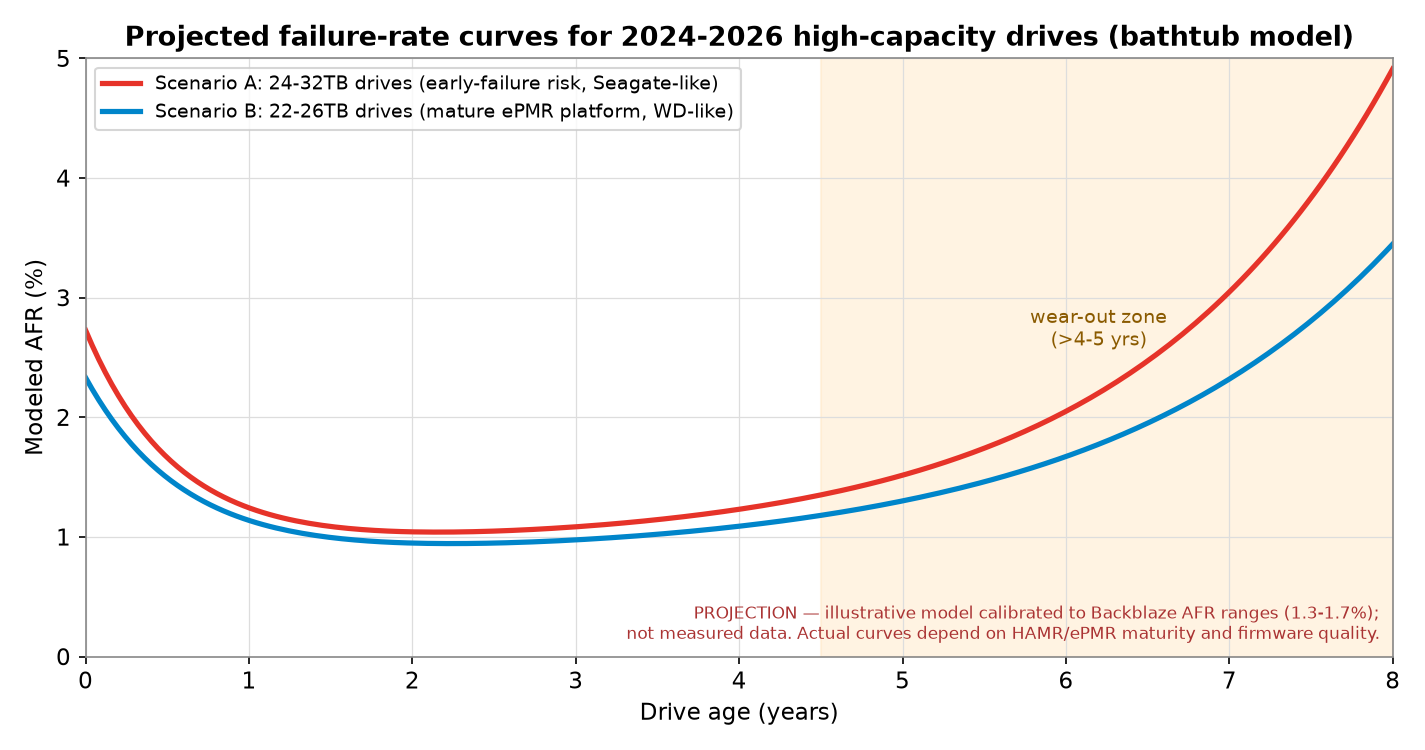
Our model (bathtub curve calibrated to Backblaze data):
- Fleet AFR should stay in the 1.2–1.5 % band through 2027–2028 as the fleet skews toward young 20–44 TB drives, then rise modestly as 2024–2026 drives pass the 4–5-year wear-out threshold (Backblaze notes AFR rises noticeably after 5 years of service).
- New platforms show infant mortality: the Seagate 24 TB (2.75 % in 2025, rising to 3.5 % in Q4 2025) is the live example. Expect first-generation HAMR (Exos M 32 TB) and UltraSMR (HC690) to run 1–2 % AFR in year one — above the 0.7 % pool average — before settling below 1 % after ~18 months. Don’t judge a new HDD family on its first two quarters.
- The 22–26 TB ePMR class (WD HC570/HC590, Toshiba MG11) is the reliability/density sweet spot: 0.4–0.7 % AFR observed; expect it to hold <1 % into 2028.
- Firmware events will keep producing phantom “failures” — as drives ship with remote-managed firmware, expect more fleet-wide incidents like the Toshiba MG08ACA16TEY Q3 2025 spike. For users: snapshot/backup before any firmware update.
- Encryption will keep raising the stakes: as SED becomes default-on for enterprise orders, the share of “unrecoverable without password” cases in recovery labs will grow. (Prediction, not measured data.)
5.3 Industry context
- Seagate FY2026 (ended 3 Jul 2026): revenue $12.195 B (up from $9.097 B), net income $3.184 B, gross margin 45.6 % — AI-driven demand has HDD production sold out through 2028, with long-term supply agreements (LTAs) covering exabytes into 2029.
- HAMR share of Seagate nearline exabytes: 40 % (mid-2026) → 70 % (by July 2027); by end of 2026 half of HAMR exabytes will be Mozaic 4 (40 TB-class).
- WD remains the ePMR density champion; Seagate leads absolute capacity via HAMR; Toshiba is third but consistent (its 28 TB SMR MA11 targets hyperscalers with SMR-optimized software).
6. Methodology and Sources
Failure data: computed from Backblaze’s public quarterly drive stats (data_Q1_2024 … data_Q1_2026 ZIP archives, backblaze.com/cloud-storage/resources/hard-drive-test-data), using AFR = failures / (drive-days/365.25) × 100, matching Backblaze’s published methodology; cross-checked against Backblaze Drive Stats blog posts (2024 annual; Q1–Q3 2025; 2025 annual; Q1 2026). Note: Backblaze’s fleet is a single (large) sample; AFR figures are fleet-specific.
Specifications: official manufacturer documents — Seagate Exos M datasheet DS2045-4; Seagate Exos M SATA Product Manual 210048100 Rev C (Mar 2025); WD press release (15 Oct 2024) and product pages; Toshiba press release (10 Sep 2024) and MG11 product page.
News: Tom’s Hardware (17 Dec 2024 Exos M launch; 15 Oct 2024 HC690/HC590; 10 Sep 2024 Toshiba; 6 Sep 2025 Exos M 30 TB review; 3 Mar 2026 44 TB Mozaic 4+; ~Jul 2026 Seagate earnings/50 TB Mozaic 5); StorageReview (22 Oct 2024).
Limitations: our 2026–2030 predictions are explicitly projections based on the bathtub model and vendor roadmaps, not measurements. The failure data reflects Backblaze’s environment (datacenter, 24/7 operation) and may not match consumer NAS/desktop usage.
Prepared for ACE Data Recovery. For the data-recovery trade: expect more SED-locked and firmware-dead 30 TB+ cases, and treat firmware updates as the new #1 preventable data-loss event.